上海歐贊自動化設備有限公司


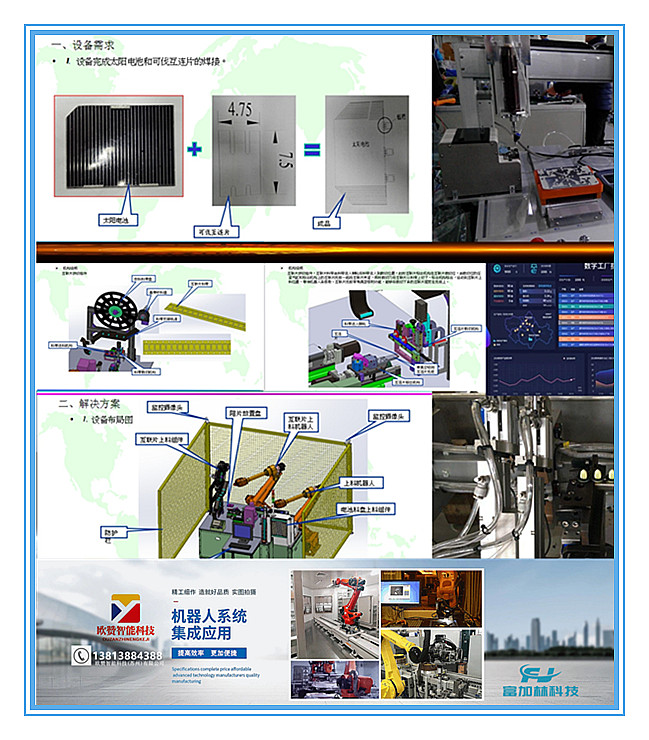
砷化鎵(GaAs)電池全自動貼片設備Fully automatic welding and patching equipment for interconnection tabs of gallium-based batteries砷化鎵電池互聯片全自動焊接貼片設備作為高技術密度裝備,其發展依托材料科學、精密制造、AI控制的協同創新,未來將隨5G/6G、新能源、智能終端的爆發式需求,向更高效率、更低成本、更廣場景方向演進,成為半 二維碼
27
發表時間:2025-09-17 16:00作者:蘇州富加林自動化科技有限公司來源:蘇州富加林自動化科技有限公司
蘇州富加林自動化科技有限公司 砷化鎵(GaAs)電池全自動貼片設備是支撐高效率、耐輻射砷化鎵太陽能電池規模化生產的核心裝備,其技術特性與應用場景緊密關聯于砷化鎵材料優勢及產業需求,具體可從以下維度系統解析:
一、核心驅動:砷化鎵電池的性能優勢
二、設備技術特點與工作原理
三、應用場景與市場格局
四、發展趨勢與挑戰
砷化鎵全自動貼片設備作為高技術密度裝備,其發展緊密依托材料科學、精密制造、AI控制的協同創新,未來將隨5G/6G、新能源、智能終端的爆發式需求,向更高效率、更低成本、更廣場景方向演進,成為半導體產業升級的關鍵支撐。砷化鎵電池互聯片全自動焊接貼片設備作為高技術密度裝備,其發展依托材料科學、精密制造、AI控制的協同創新,未來將隨5G/6G、新能源、智能終端的爆發式需求,向更高效率、更低成本、更廣場景方向演進,成為半導體產業升級的關鍵支撐。 Suzhou Fujialin Automation Technology Co., Ltd The fully automatic surface mount equipment for gallium arsenide (GaAs) cells is the core equipment that supports the large-scale production of high-efficiency and radiation resistant GaAs solar cells. Its technical characteristics and application scenarios are closely related to the advantages of GaAs materials and industry demand. Specifically, it can be systematically analyzed from the following dimensions: Space solar cell group dual robot welding station. jpg 1、 Core driver: Performance advantages of gallium arsenide batteries Ultra high conversion efficiency: The laboratory efficiency of single junction gallium arsenide batteries has exceeded 30%, and mass production has remained stable at over 28%; The theoretical efficiency of three/four junction stacked cells can reach 40% -50%, far exceeding that of crystalline silicon cells (theoretical 23%), and the unit area power generation can be increased by 20% -30%, especially suitable for limited space scenarios such as satellites, vehicle systems, and curved BIPV. Extreme environmental adaptability: resistant to a wide temperature range of -40 ℃ to 85 ℃, high radiation, and humidity, with a lifespan of over 25 years. It is the mainstream choice in the aerospace field (accounting for more than 95% of global space power supply) and high-altitude/dusty areas. Lightweight and flexible: Rigid cells are used in large photovoltaic power plants, while flexible cells (0.8kg/㎡) can fit curved surfaces and adapt to innovative scenarios such as drones, wearable devices, and building photovoltaic integration (BIPV). 2、 Technical characteristics and working principle of equipment Automation and Precision Control: Using high-precision robotic arms, visual recognition systems, and AI algorithms, precise positioning, picking, and mounting of battery cells are achieved with a mounting accuracy of micrometer level and a speed several times faster than manual labor. Material compatibility design: Based on the characteristics of gallium arsenide thin films (5-10 μ m thickness), integrated anti-static and anti pollution modules, combined with epitaxial growth (MOCVD/VGF method), cutting, and mounting integrated processes, ensure non-destructive treatment of the material. Intelligent integration: Real time monitoring of production parameters (such as temperature, pressure, speed) through the Internet of Things (IoT), combined with big data optimization of processes, to improve yield and production capacity. 3、 Application scenarios and market patterns Aerospace and Space Applications: Leading the power supply for satellites, space stations, and detectors, with 93% of the global market for triple junction gallium arsenide batteries. China's commercial satellite opening promotes private enterprises (such as Qianzhao Optoelectronics and Kaixun Optoelectronics) to accelerate localization. Ground and emerging fields: Ground focused photovoltaics (CPV), 5G base stations, IoT devices, electric vehicles, medical equipment, etc. The efficiency of the focusing system has exceeded 40%, and the cost has decreased with technological iteration. Competitive landscape: International leaders (Qorvo, Skyworks, AXT) dominate the high-end market, while domestic enterprises (Shanghai Space Power Research Institute, Suzhou Fujialin Automation Technology Co., Ltd.) gradually replace imports through breakthroughs in 8-inch single crystal preparation and heterogeneous integration technology. The global market size is expected to increase from 40.75 million US dollars to 54.55 million US dollars from 2023 to 2029, CAGR 5%。 4、 Development Trends and Challenges Technological innovation: Large scale (8-inch single crystal), heterogeneous integration (silicon-based/germanium based), green manufacturing (low-energy VGF method), cutting-edge fusion of neural morphology computing/terahertz communication, etc. Application Expansion: Extending from aerospace to ground focused, vehicle mounted, and intelligent terminals, such as autonomous driving sensors and quantum computing optoelectronic modules. Challenges and Countermeasures: High cost (materials+processes), technical barriers (large size and low defect preparation), environmental requirements (green processes), need to be overcome through domestic substitution, large-scale production, and cross disciplinary cooperation (such as photonic crystal fiber and spintronics). Flexible intelligent precision assembly production line. png As a high-tech density equipment, the development of gallium arsenide fully automatic surface mount equipment relies closely on the collaborative innovation of materials science, precision manufacturing, and AI control. In the future, with the explosive demand for 5G/6G, new energy, and intelligent terminals, it will evolve towards higher efficiency, lower cost, and wider scenarios, becoming a key support for the upgrading of the semiconductor industry. As a high-tech density equipment, the fully automatic welding and surface mounting equipment for gallium arsenide battery interconnect chips relies on collaborative innovation of material science, precision manufacturing, and AI control. In the future, it will evolve towards higher efficiency, lower cost, and more square scenery with the explosive demand of 5G/6G, new energy, and intelligent terminals, becoming a key support for the upgrading of the semiconductor industry. |